Back to »
Mastering client negotiations
In this episode I talk to Florence Rolland from Negotiate about mastering client negotiations.
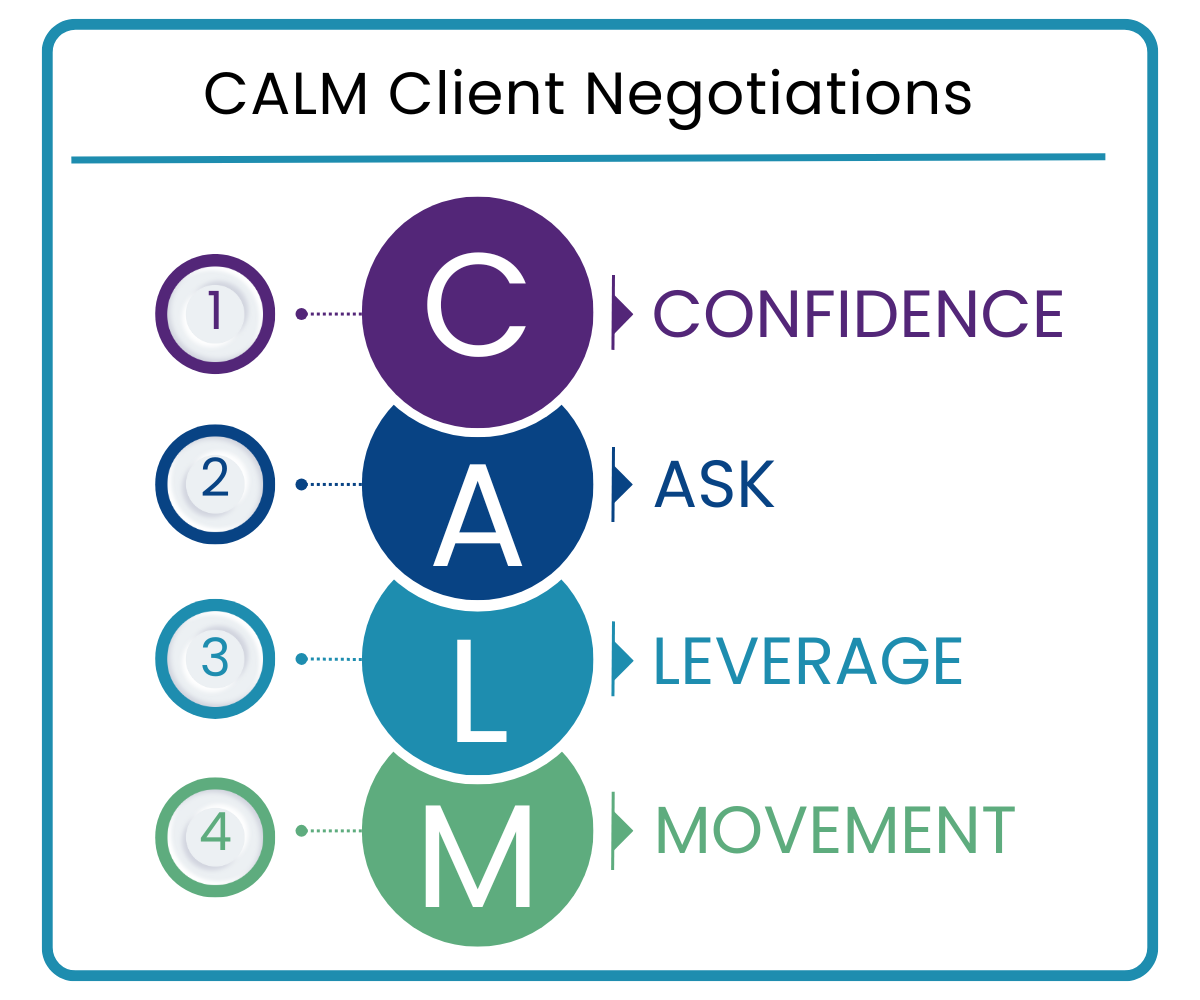
Florence shares how to transform difficult client relationships into collaborative partnerships. Learn how to build confidence to set boundaries, ask the right questions to find common ground, leverage your position effectively, and decide what to compromise on versus what's non-negotiable.
Watch the episode
Video editing by Squinty Pixels. Slightly dodgy lighting & sound, TheIBG.
Get personalised insight and advice from Florence by taking our quick quiz.

Show notes
Section 1: Confidence – building the confidence to negotiate
How can a business owner build the confidence to address and work with a client, and make sure they are getting the best from that relationship?
Florence: Confidence is a key skill in negotiation. It does not matter whether your client is accommodating or quite difficult. You need a confident approach to get as much as you can from the conversation. The most important thing is to be well prepared, and I do not just mean have a quick think about it five minutes before you turn up. Have a plan. Write it down. Think about where you can and cannot move and what is really important to you. If you can write down what you need and then practise saying it out loud, either alone or with a colleague, you will find it much easier to say in front of a client.
Florence: Second, do not give in too easily. People will push you, and you have to understand that is normal. They are testing you, trying to find out where they can get more. Do not give in just to be nice. There needs to be a point you will not go past, and you should not give anything away unless you get something back in return.
Florence: Third, try to separate your emotions from the negotiation. This can be difficult, especially when it is your own business and it feels personal. But when someone is being difficult across the table, it is usually not because they dislike you. They are probably nervous, or they have strong views and are pushing in a way that works for them. It is not a personal attack. Think like a negotiator. You are doing a job, and you can only do it well if you keep emotion out of it.
Florence: If you find yourself getting defensive or upset, stop and take a breath. It is fine to take a moment. It is fine to say nothing immediately and respond once you have thought it through. And if things have become really complex, it is perfectly acceptable to say: I need to think about this properly. I will come back to you tomorrow with a considered response.
Shona: That is a really good point. And in a negotiation with multiple elements, you can also just park one point and come back to it later rather than letting it block the whole conversation.
Florence: Exactly. You can say: we seem to have different information on this, so let’s set it aside and move forward with what we can agree on, and I’ll come back to you on that point once I’ve checked the facts. That is a very useful skill.
Section 2: Asking – asking the right questions to find common ground
When going into a client negotiation, what should you be asking, and how do you make sure you understand what the client actually needs?
Florence: There are two aspects to asking. One is having the confidence to ask for what you need. The other is asking the right questions to understand the other person. I think the second is almost more important, because you already know what you want. You have done your preparation. But when you meet the client, do you really know what they want and how much they want it?
Florence: You need to ask good open questions, not closed ones. Think of negotiation as a search for understanding. If you do not understand what the other person wants and why, you cannot put forward a deal that works as well as it could. Get behind the data. It is not just about the price, but what is driving that price. It is not just about the delivery time they have asked for, but why they need it then and whether there is any flexibility. You are looking for information and options.
Florence: A client of mine recently had an inheritance dispute with his sister over a piece of farmland. He needed access to a small track of land she owned and had offered her money repeatedly. She refused every time. I asked him if he had asked her what she actually wanted. He had not. It turned out she did not want money at all. She wanted their father’s old Jaguar, which had a lot of sentimental value for her. He got the land access, she got the car. Problem solved. The right question changed everything.
Shona: I think people sometimes feel that asking questions shows weakness. But the opposite is true, isn’t it?
Florence: Yes. Not asking a question does not make you look strong. It makes you look uninterested. Asking shows you care and that you are trying to find something that works for both sides. But it does matter how you ask. Be assertive and clear. And once you have asked, listen properly to the answer. Do not make assumptions about what you hear. Summarising what you have understood at the end is a good way to check you have got it right.
Section 3: Leverage – using your position effectively
What leverage does a business owner have when talking to a client, and how should they use it without being heavy-handed?
Florence: Leverage is not something to batter someone with. It is about finding ways to encourage movement. The first thing to recognise is your own value. We often forget how important our services are to the person buying them. When a client implies they could take their business elsewhere, it is easy to let that undermine your confidence. Do not let it. If you do not value what you offer, nobody else will.
Florence: A really useful tool is thinking about your tradables. A tradable is something that is relatively cheap or free for you to give, but adds value to the other person. The key is that you only use tradables in exchange for something. They are not giveaways. For my business, a tradable might be extending a post-workshop helpline from 30 days to 60 or 90 days. It costs me very little, but it feels like real added value to the client. I can use that to push back on price pressure. If they want a higher price to hold, I can offer that as an extra in return.
Florence: The other thing to think about is priorities. What matters most to them? Once you know that, you can use it to get what you need. People value things differently in a negotiation. The price might be the priority for your client, but for you it might be payment terms. If you can offer a slightly lower price in exchange for payment within seven days, you are trading on something you both value differently. That is the heart of good negotiation.
Section 4: Movement – deciding what to compromise on and what is non-negotiable
How do you decide before going into a negotiation what you are willing to move on and where your limits are?
Florence: This should all be part of your preparation before you go in. Think about your own priorities. What can you absolutely not give up? That is your highest priority, and you need to hold firm on it. Then there are things that are important but not critical, where you have some flexibility. And then there are things that would be good to get but are not essential. Spend time mapping those out before you sit down, and you will have a much clearer view of what a good deal looks like and where trades are possible.
Florence: Linked to that is your exit point. How far are you prepared to go before it stops being a good deal? If it goes past that point, be prepared to walk away. Do not be pushed beyond what works for your business. A deal that is not profitable or not deliverable is worse than no deal at all. Have an exit point for each of your negotiable issues, and hold to it. That clarity is what gives you the confidence not to be pushed over.
Florence: And finally, think about the trading aspect of movement. Good negotiation is not one-sided. It is not just demanding things, and it is not giving things away freely either. The principle is: if you give me this, then I will give you that. Those two words, if and then, make a real difference to outcomes. You move together, not in one direction.
Shona: That asking stage really does feed into this, doesn’t it? The more you understand their priorities in that earlier conversation, the clearer you are about what tradables and movement points will actually work when it comes to reaching a deal.
Florence: Exactly. It all connects. The preparation, the questions, the leverage, and the movement. Each part supports the others.
Getting in touch
Shona: Thanks very much Florence. We have been talking about confident client negotiations, covering confidence, asking the right questions, leverage, and managing movement. If you want to find out more or get in touch with Florence, the website and LinkedIn links are below.
Florence: Thank you for having me.
Links

Do you have a question for our experts?
Submit your question here and if it fits with our current and planned content, we’ll find a supplier to answer your question via either our podcast or our blog.

Interested in being featured in our podcast or blogs?
We ask some of our expert suppliers, who we have carefully vetted, to provide expert advice via our podcast and our blog. If you would like to find out more about this we are inviting potential contributors to register your interest.